
How to Choose a Home Care Agency in Toronto
Choosing a home-care agency is an important decision, especially when you're helping a parent or family member find support to continue living comfortably and independently at home.
You may have already explored several agencies in Toronto and the Greater Toronto Area (GTA). Many offer similar services, including companionship, personal support, nursing, and assistance with daily routines.
Understanding how those services are assessed, coordinated, and delivered can help you compare agencies more confidently.
Who determines what support is appropriate? Who coordinates visits? What happens when circumstances change? How will your parent's preferences be respected?
These seven considerations can help you make an informed decision.
1. Start with the support you actually need
Before comparing agencies, consider what a typical day looks like for the person receiving care and where additional support could make a meaningful difference.
For one person, the priority may be companionship and regular social interaction. Another may benefit from assistance with bathing, dressing, mobility, or other daily activities. Someone returning home after a hospital stay may require a different arrangement.
Understanding these needs helps identify the appropriate type of support and qualifications.
Common home-care services include:
Companionship: Conversation, social interaction, appointment accompaniment, grocery outings, light housekeeping, non-clinical medication reminders where appropriate, and assistance with other everyday activities.
Personal support: Assistance with activities of daily living, including bathing, dressing, mobility, and personal routines.
Coordinated home care: Organization of agreed services, scheduling, communication, and adjustments as needs change.
Nursing and clinical support: Nursing services arranged through appropriately qualified professionals, based on assessed needs and each professional's authorized scope of practice.
Some care arrangements involve more than one category of support. An assessment can help determine the appropriate combination.
When speaking with an agency, describe the activities or situations where assistance would be helpful. A first conversation can begin with a simple description of your circumstances.
A useful question: Based on what I've described, which services would you recommend assessing, and why?
2. Understand how the agency assesses your needs
A home-care arrangement should begin with an understanding of the person receiving support.
An assessment may consider daily routines, mobility, personal preferences, the home environment, existing family support, and relevant health considerations.
Ask how the agency gathers this information, who develops the care plan, and how the person receiving support participates in the process.
At Garrison Care, our assessment and care-planning process is supported by registered nurse oversight, with clinical involvement appropriate to each client's needs.
The assessment helps establish a care arrangement that reflects the person's circumstances, preferences, and support requirements.
When comparing providers, ask:
Who conducts the initial assessment?
What information is considered?
How is the person receiving care involved?
Will there be a written care plan?
How are changes in needs reviewed?
A clear assessment process helps families understand how recommendations are made and what support may be appropriate.
3. Find out who coordinates the care
The quality of a home-care arrangement also depends on how services are organized and communicated.
Imagine your parent receives personal support several mornings a week. An upcoming medical appointment requires a change to the usual schedule.
Who should you contact? Who confirms whether the visit can be adjusted? How will your parent know what has been arranged?
These are important coordination questions.
Before choosing a provider, establish who manages scheduling, communicates changes, and responds when something needs attention.
At Garrison Care, care arrangements are guided by an assessment and documented care plan. We coordinate agreed services, scheduling, and communication, with clinical oversight appropriate to the client's needs.
Our approach emphasizes clear responsibilities so clients and families understand whom to contact and how care arrangements are managed.
A useful question: If something changes or I have a concern, who is responsible for helping me resolve it?
4. Ask about qualifications, oversight, and accountability
Home-care professionals enter personal spaces and become part of everyday routines. Understanding how an agency verifies qualifications and manages responsibilities is an important part of choosing a provider.
Ask how the agency checks credentials, prepares workers for assignments, and addresses concerns about service delivery.
Depending on the services involved, questions may include:
What qualifications are required for the people providing support?
How are nursing registrations and other applicable credentials verified?
Who oversees the care plan?
How are service concerns documented and addressed?
What arrangements are available if an assigned worker cannot attend?
In Ontario, different care roles have different professional and regulatory requirements. Nurses must hold the appropriate registration with the College of Nurses of Ontario.
You can also ask about the agency's business documentation, applicable licensing, and insurance.
Garrison Care holds Ontario temporary help agency and recruiter licences and maintains business insurance relevant to its operating model. Nursing services are coordinated through appropriately qualified professionals working within their authorized scope of practice.
The purpose of these questions is to understand who is responsible for each part of the care arrangement and how concerns will be addressed.
5. Clarify schedules, communication, and costs
Once you've established that an agency offers suitable services, discuss how the arrangement would work in practice.
Several details deserve attention:
Scheduling: How are visits arranged? What notice is required to request changes?
Communication: Who receives updates? How are preferences about family involvement respected?
Continuity: What arrangements are available when the usual worker is unavailable?
Costs: What is included in the quoted rate? Are there minimum service hours, cancellation terms, or additional charges?
Agreements: What responsibilities belong to the agency, the worker, and the client?
Ask for important terms in writing before agreeing to services.
When comparing quotes, make sure they describe comparable arrangements. An hourly rate may include different levels of coordination, assessment, supervision, or additional services.
Consider the overall fit between the proposed services, costs, responsibilities, and the person's needs.
A clear understanding of these details helps families make informed decisions and establish realistic expectations.
6. Compare agencies using the same questions
After speaking with several home-care agencies, remembering the differences can become difficult.
Using a consistent set of questions makes the comparison easier.
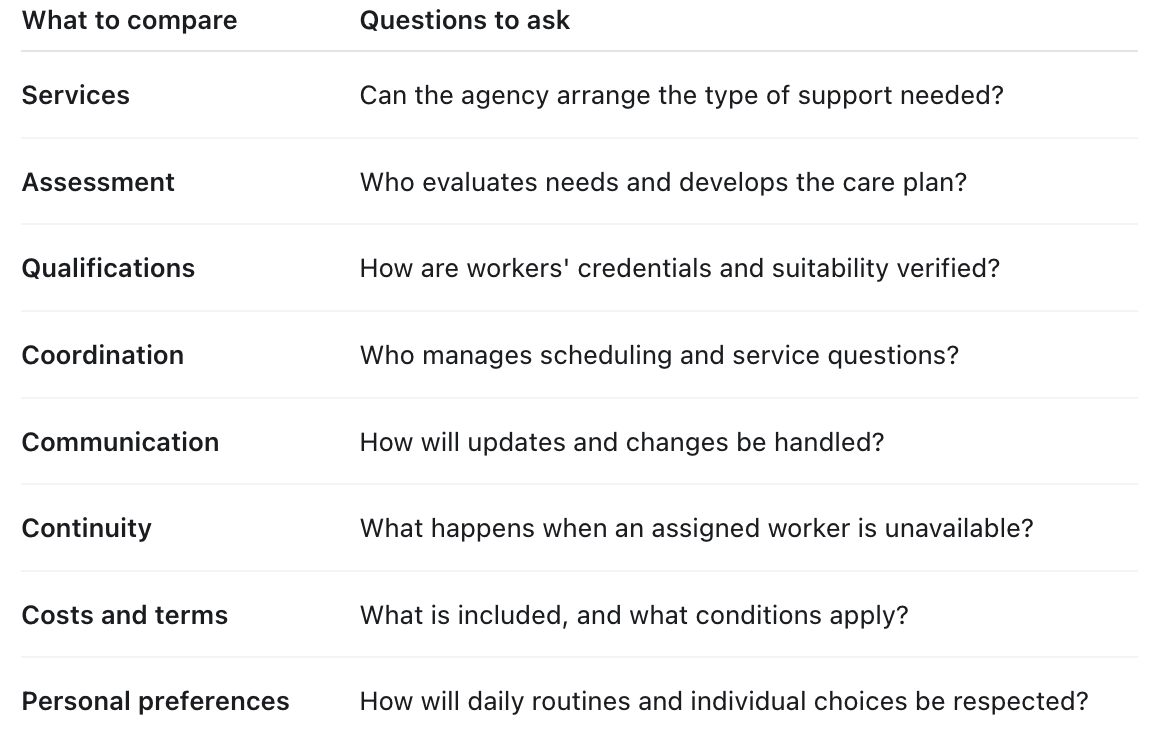
A printable version of this comparison is available to use during your calls. [Download the comparison Home Care Agency Comparison Checklist (PDF)
Different agencies may approach these responsibilities differently.
Look for clear explanations, written information where appropriate, and an approach that reflects the needs and preferences of the person receiving care.
If an answer is unclear, ask for further details before making a commitment.
7. Know what to expect when you contact an agency
An initial inquiry is an opportunity to describe your circumstances, ask questions, and understand the agency's process.
You can begin by sharing a few details:
The type of support you're considering.
Where the support would be needed.
Whether you're exploring options for the future or arranging support soon.
Any daily routines or personal preferences that matter.
Questions about assessment, scheduling, and costs.
The agency can then explain its approach, discuss potential service options, and identify appropriate next steps.
Garrison Care offers a complimentary initial care consultation to discuss your needs, explain our process, and explore suitable care arrangements.
Depending on the circumstances, next steps may include a more detailed assessment, care planning, and scheduling discussions. Services are subject to individual assessment and staffing availability.
The initial conversation is a practical starting point for understanding your options.
Choosing care should leave you better informed
Choosing a home-care agency means understanding how support will be assessed, delivered, coordinated, and reviewed. It also means understanding how the arrangement will respect the person receiving care.
Take time to ask questions, compare answers, and understand the responsibilities and terms before proceeding.
Most importantly, include the person receiving support in the conversation wherever possible. Their preferences, routines, and priorities deserve a meaningful place in the decision.
Considering home care in Toronto?
Garrison Care offers companionship, personal support, and coordinated home care, and arranges nursing and clinical support through appropriately qualified professionals.
We serve Toronto and the Greater Toronto Area, with services subject to assessment and staffing availability.
If you're exploring support for yourself, a parent, or another family member, we're here to help you understand your options.
Start with a complimentary care consultation.