
When you're exploring home care for a parent or someone close to you, one of the first questions is often what kind of help to arrange.
Would companionship be enough? Would a personal support worker (PSW) be a better fit? Is nursing care needed?
The answer begins with what the person wants help with, how often that support would be useful and whether any clinical care is involved.
Understanding the differences can help you ask better questions when speaking with a home-care provider in Toronto or across the GTA.
Start with the support needed
Imagine three different situations.
An older adult enjoys living independently and would appreciate regular company and help with a few everyday routines.
Another person would like help getting dressed, bathing or managing parts of their morning.
A third person has a health concern that calls for a nursing assessment or a specific clinical intervention.
Each situation points toward a different kind of support, and sometimes a person's needs span more than one.
The best starting point is the person and how their day goes. The right role follows from there.
What does a companion do?
Companionship focuses on social connection and everyday, non-clinical support.
Depending on the service arrangement, a companion might share conversation and activities, join someone on an outing, accompany them to appointments, help with groceries or assist with light household tasks.
For example, a parent who spends much of the week alone may enjoy someone visiting regularly to share an activity, prepare a simple meal together or head out on an outing.
Companionship can be valuable even when a person manages their personal care independently.
A useful question to ask: What activities would make everyday life more enjoyable, connected or manageable?
When hands-on personal care or clinical needs come up, a PSW or nurse can work alongside companionship.
What does a personal support worker (PSW) do?
A PSW commonly assists with personal care and activities of daily living.
Depending on the person's needs, the worker's training and the care plan, this may include help with bathing, dressing, grooming, toileting, eating or moving around safely.
For example, an older adult may be comfortable spending much of the day independently and would welcome help getting ready in the morning. A PSW could support that part of the routine.
PSWs also bring reassurance and social interaction to their visits, and they can provide companionship as part of an agreed care arrangement. That continuity can be helpful as a person's needs change over time.
A useful question to ask: Which daily activities are becoming harder, and what level of help would the person welcome?
PSWs provide support within their training, competence and care arrangements. Nurses bring regulated clinical expertise when the person's needs call for it.
What does a nurse do?
Registered nurses (RNs) and registered practical nurses (RPNs) are regulated nursing professionals in Ontario.
Nursing support becomes relevant when a person's needs call for clinical assessment, monitoring or nursing interventions. A nurse may also work alongside a PSW as part of a coordinated care plan.
Examples may include wound care, clinical assessments or other nursing services identified through the person's care plan. Nurses provide this care within their scope of practice and competence.
A useful question to ask: Is there a health concern that would benefit from assessment or care by a regulated nursing professional?
The nursing professional and services involved depend on the person's condition, care requirements and practice context.
PSW vs. companion vs. nurse: what's the difference?
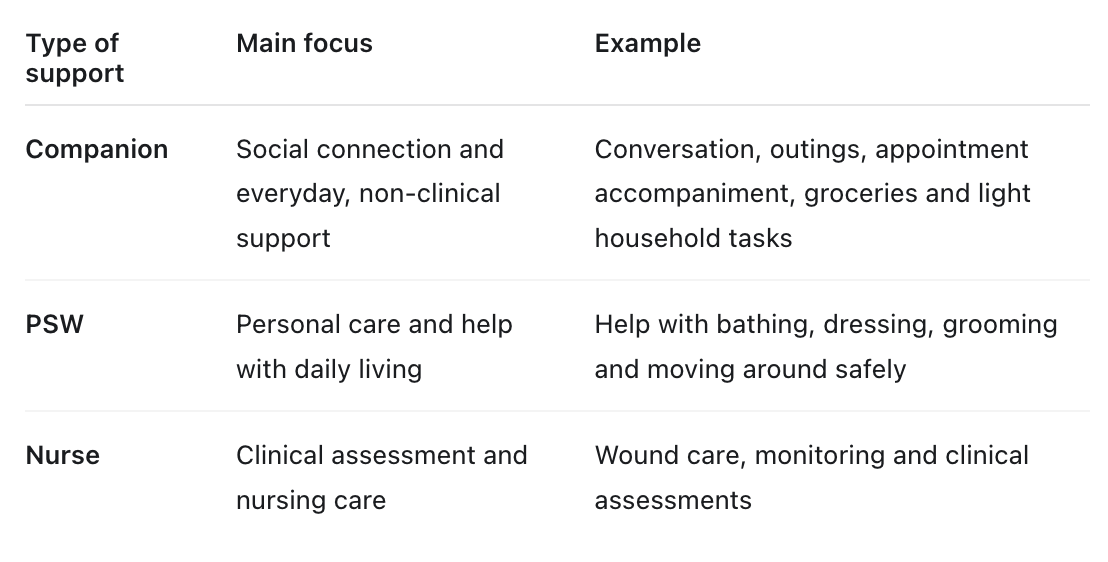
Use this comparison as a starting point. An assessment fills in the details for each person.
Can someone need more than one type of support?
Yes.
A person might enjoy companionship during the week and personal support at specific times of day. Another person may benefit from personal support alongside nursing care.
Needs can also change after an illness, a hospital stay or a shift in daily routines.
Some families use one service and others combine a few. The arrangement follows the person's circumstances.
When several workers are involved, it helps to know who coordinates the care plan, how changes are communicated and whom to contact with questions.
At Garrison Care, care begins with an assessment involving our Director of Care and an individualized care plan. Our Coordinated Home Care service helps organize personal support and nursing services around that plan, with communication arrangements established according to the client's preferences and care needs.
How do you decide where to start?
These questions are worth talking through together before your first conversation with a home-care provider:
What does the person want help with?
What would the person like to keep doing independently?
Would hands-on personal help make parts of the day easier?
Is there a health concern that calls for professional assessment?
How often might support be useful?
Which preferences, routines and goals matter most to the person receiving care?
Open questions are a fine place to start. An initial conversation can help clarify what to explore further and whether an assessment would be useful.
What about publicly funded home care?
In Ontario, Ontario Health atHome is a point of contact for assessment and coordination of eligible publicly funded home and community care services.
Families may explore that pathway alongside private home-care options, depending on their circumstances. Eligibility, available services and arrangements are best confirmed directly with Ontario Health atHome.
Talk through your home-care needs
If you're considering companionship, personal support or nursing care for a parent in Toronto, Garrison Care can help you explore the support that fits.
We begin with a conversation about your circumstances. An assessment with our Director of Care then shapes a care plan, schedule and service arrangement, with fees confirmed before care begins.
We can discuss your needs, explore suitable services and explain the next steps.
Contact Garrison Care to start the conversation.