Sharing the Caregiving Load: A Guide for Families Who Are Already Trying
When everyone in a family is contributing to a parent's care, it can still feel like something is missing. Not effort, there's plenty of that. What's often missing is a shared picture of who is doing what, and how the whole arrangement holds together. This guide is for families who are already showing up and want to make sure the load they're carrying is actually shared, not just unevenly distributed in ways no one has named yet.
Why the Caregiving Load Feels Heavier Than It Looks

From the outside, things may look manageable. The parent is still at home. Appointments are happening. Groceries are getting picked up. Family members are checking in.
But behind the scenes, one person may be holding most of the mental load.
That can include:
Remembering appointments and follow-ups
Tracking medication changes
Noticing changes in mood, memory, meals, or mobility
Coordinating siblings or extended family
Managing paperwork, bills, transportation, or home repairs
Wondering whether a small change means something more
This is often where caregiving begins to feel unsteady. The tasks may be getting done, but the responsibility is not always shared.
There is an important distinction worth naming here. Being involved is not the same as being responsible. Sharing tasks is not the same as sharing awareness. A family can have multiple people contributing and still have one person carrying the full picture alone. That gap is where quiet strain begins.
Sharing the Caregiving Load Starts With Making the Work Visible
Many families care with good intentions but without a shared structure. One person naturally steps in more often because they live closer, have more flexibility, or are more emotionally attuned to changes.
That can work for a while. Over time, it creates quiet strain.
Sharing the caregiving load begins by naming what is already happening.
A simple starting point is to write down:
Who books or tracks appointments
Who communicates with doctors, pharmacists, or service providers
Who checks the home environment
Who helps with groceries, meals, or errands
Who manages finances, paperwork, or forms
Who notices changes and shares updates
Who provides emotional support to the parent
Once the work is visible, the family can see whether the load is balanced, unclear, or resting too heavily on one person.
What It Actually Means to Coordinate Care for an Aging Parent

Coordinating care for an aging parent involves more than scheduling appointments or managing medications. It includes tracking changes in health, mood, mobility, and cognition over time; communicating clearly with medical and service providers; managing the home environment for safety and comfort; monitoring financial and legal matters as needs evolve; and recognizing when the current level of care is no longer enough.
When this coordination happens informally, through group texts, phone calls, and whoever is available, it tends to concentrate in one person without anyone deciding that should happen.
A Simple Care System Families Can Actually Use
Coordinating care for an aging parent does not require a perfect plan. Most families need a few repeatable systems that reduce confusion and keep everyone informed.
A simple care system includes:
One shared place for updates, a document, an app, or a consistent message thread
One calendar for appointments and reminders
One list of key contacts, medications, and service providers
Clear responsibility areas, who handles what, and who is the point of contact for each
A regular check-in rhythm, weekly or biweekly keeps the picture current
A shared understanding of when the arrangement may need outside support
The system should be simple enough that people will actually use it. A complicated setup creates more work. A simple rhythm creates steadiness.
Normal vs. Worth Addressing
Not every imbalance signals a problem. Roles shift. Life circumstances change. Some unevenness is natural and temporary. The question is whether the arrangement is sustainable, and whether the people inside it have named it honestly.
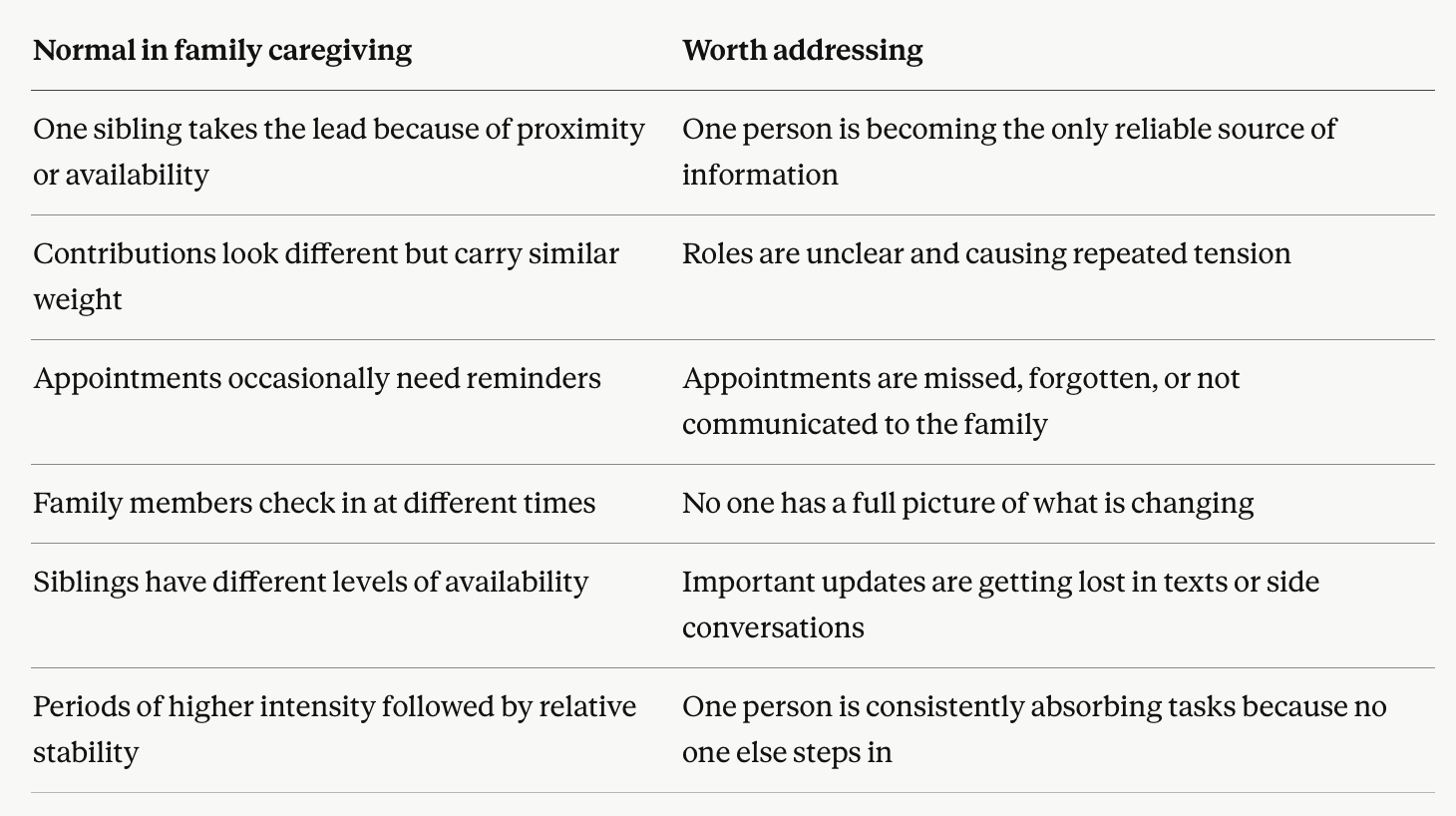
The issue is not whether every family member does the same amount. The issue is whether the arrangement is clear, sustainable, and understood by everyone in it.
When to Clarify Family Caregiver Roles and Responsibilities
Consider moving toward clearer roles and a more structured approach when:
One person is becoming the default coordinator for everything
Family members have different understandings of the parent's current situation
Important decisions are being deferred because no one wants to raise them
A primary caregiver is showing signs of exhaustion
A medical event, hospitalization, or new diagnosis has changed the level of need
A paid or professional caregiver has been introduced and needs to be coordinated with family
The family is geographically dispersed and communication is inconsistent
The family feels reactive rather than steady
How to Talk About Sharing the Caregiving Load
These conversations are some of the most important a family can have, and some of the easiest to avoid. The best ones begin with clarity, not blame.
What works
"Can we map out what each of us is already doing?"
"I want to make sure nothing important is living in one person's head."
"Let's look at what Mom needs each week and work from there."
"Can we agree on one place where updates will go?"
"What feels realistic for each of us right now?"
What tends to make it harder
"I'm the only one doing anything."
"You never help."
"Everyone needs to do more."
"We need to figure this out right now."
A calmer approach helps the family focus on the system rather than turning the conversation into a personal conflict. Raising this during a crisis, when everyone is already stretched, rarely leads to a productive outcome. When possible, choose a quiet moment, not a charged one.
How to Divide Caregiving Responsibilities Without Resentment
Resentment in family caregiving almost always traces back to one of three sources: invisible labour that was never acknowledged, roles that were assumed rather than agreed upon, or contributions that were measured unequally.
A few principles that help:
Acknowledge before reorganizing. Before anyone agrees to do more or less, name what is already happening, including the contributions that rarely get credit.
Match roles to reality, not history. The sibling who stepped up during a health crisis two years ago should not automatically remain the primary coordinator indefinitely. Revisit roles as circumstances change.
Build in a review. Agreeing to a caregiving arrangement without a plan to revisit it is how temporary situations become permanent ones. A brief family check-in every few months keeps the arrangement honest.
FAQ
How do I start coordinating care for an aging parent?
Start by listing what your parent needs in a typical week, appointments, meals, transportation, medications, home safety, companionship, paperwork, and check-ins. Then identify who is already helping and where the gaps are. Visibility comes before coordination.
How can siblings share caregiving responsibilities more fairly?
Begin with the full picture before assigning tasks. Fair does not always mean equal, it means responsibilities are clear, realistic, and not silently falling to one person. Specific requests get specific answers. Asking generally for more involvement rarely moves things forward.
What should a simple care plan for aging parents at home include?
Key contacts, medication information, appointment tracking, home safety notes, family roles and responsibilities, emergency contacts, and a regular check-in rhythm. It should be easy to update and easy for every family member to understand and access.
What is caregiver burnout and how do families recognize it?
Caregiver burnout is physical, emotional, and mental exhaustion that develops when someone has been managing a significant caregiving load without adequate support or relief. Signs include persistent fatigue that rest doesn't resolve, growing resentment toward the role, withdrawal from personal relationships, and a sense that nothing is ever enough. It is not a character failure. It is what happens when a sustainable arrangement becomes unsustainable without anyone adjusting the load.
Related Reading
This article is the companion resource to Week 47 of The Care Standard — The Calm Control Week — which explores why calm in a caregiving arrangement isn't something you find. It's what good structure produces.
Garrison Care supports older adults and families navigating aging at home with calm, practical guidance rooted in dignity, clarity, and care coordination.