Home Safety Checklist for Aging Parents: Room by Room
Most families do not set out to overlook the risks in a parent's home. They simply stop seeing them. The hallway that has always been dim. The bathroom with no grab bar. The rug that has been by the door for twenty years. Familiarity is not the same as safety — and that gap is where most household hazards quietly live.
This guide walks through the rooms that matter most, what to look for in each one, and how to have the conversation when something needs to change.
How to Make a Parent's Home Safer Without Overhauling It
The most common misconception families bring to this process is that making a parent's home safer means making it look clinical, institutional, or different. It does not.
Many of the most meaningful changes are small, inexpensive, and invisible once they are in place. A motion-sensor nightlight. A non-slip mat. A grab bar positioned where a hand already reaches. Frequently used items moved from high shelves to counter height.
The goal is not to transform the home. The goal is to help it continue supporting the person living there.
Start with the rooms that carry the most daily risk. Work through them one at a time. There is no need to rush.
Room-by-Room Home Safety Guide for Aging Parents
The Bathroom
The bathroom is where the highest concentration of fall risk lives. Wet surfaces, transitions in and out of the tub or shower, and the effort of getting up from a low toilet create moments where balance is most challenged.
What to check:
Is there a grab bar inside the shower or tub, and one beside the toilet?
Is there a non-slip mat inside the tub or shower, and a bath mat outside it?
Is the toilet seat at a comfortable height, or would a raised seat reduce strain?
Is there adequate lighting, including for nighttime use?
Are frequently used items within easy reach without stretching or bending?
A walk-in shower with a fold-down bench and handheld showerhead removes the single biggest transition risk in most bathrooms.
The Bedroom
The bedroom matters most at night, when lighting is low and alertness is reduced. The path from bed to bathroom is one of the most common fall locations for older adults.
What to check:
Is the path from the bed to the bathroom clear of furniture, cords, and clutter?
Is there a lamp or nightlight reachable from the bed without getting up?
Is the bed at a height that allows sitting and standing without significant effort?
Is there something stable nearby to assist with standing, such as a bedside rail or firm chair?
Are medications and essentials within easy reach?
The Kitchen
The kitchen presents risks of a different kind: reaching, bending, carrying, and sustained standing. Many families notice changes in how a parent cooks before they notice changes in how they move.
What to check:
Are frequently used items stored between counter and shoulder height?
Is there a stable stool or chair available for tasks that require sustained standing?
Are spills cleaned promptly, and is the floor surface non-slip?
Are heavy pots and appliances manageable without significant strain?
Is the lighting adequate for reading labels and working safely?
A kitchen that has always worked can become effortful in ways a parent may not name. Watching how the space is being used often tells more than asking.
The Entryway and Hallways
Entryways and hallways are transition spaces — the places a parent moves through rather than stops in. That is why hazards there often go unnoticed the longest.
What to check:
Is there a stable place to sit while putting on or removing shoes?
Are rugs secured or removed entirely?
Is lighting adequate throughout, including at the top and bottom of any stairs?
Are pathways clear of shoes, bags, cords, and other items on the floor?
Is there a railing on both sides of any staircase?
Loose rugs and poor lighting in hallways are among the most consistent contributors to falls at home. They are also among the easiest to address.
The Living Room
The living room is where a parent spends much of their time, which makes furniture arrangement and chair selection more consequential than they might appear.
What to check:
Are chairs and sofas firm enough to support easy standing?
Are pathways between furniture wide enough for clear movement, especially with a walker or cane?
Are cords tucked away or secured along walls?
Is lighting sufficient for reading and moving safely in the evening?
Is the remote, phone, and other frequently used items within easy reach from the primary seating position?
The Laundry Room and Basement
These areas carry risk disproportionate to how often they are used. Stairs, uneven surfaces, carrying loads, and reduced lighting all contribute.
What to check:
Is the basement used regularly, and is there a safer alternative for laundry if stairs are a concern?
Is there a sturdy handrail on any stairs leading to lower levels?
Is the laundry machine at a height that does not require excessive bending?
Is the floor clear of items that could shift underfoot?
Some families find that relocating laundry to the main floor, or arranging for laundry assistance, removes a risk before it becomes an incident.
Fall Prevention for Seniors in Toronto: What the Research Shows
For families in Toronto and across the GTA thinking about fall prevention for seniors, the pattern in the research is consistent: the highest-risk moments are the most ordinary ones.
Getting up from a chair. Stepping out of the tub. Turning around quickly. Moving through the house at night. Carrying something while navigating a threshold.
Falls are the leading cause of injury-related hospitalization for older adults in Canada, and the majority happen at home. Most are preventable.
The factors that raise risk most significantly are a combination of environmental and physical: poor lighting, unstable surfaces, reduced balance, slower reaction time, and medications that affect steadiness. Addressing the environment is something families can do directly. It does not require a medical assessment to install a grab bar or remove a rug.
That said, a formal home assessment by an occupational therapist can be useful when needs are more complex, when a parent has recently experienced a fall, or when physical changes are significant enough that the family is uncertain what they are looking at.
Working Through a Home Safety Checklist for Aging Parents
A home safety checklist for aging parents works best when it is used as a starting point for observation, not a grading system.
The goal is to look at the home the way a thoughtful stranger might — without the familiarity that makes hazards invisible. Room by room. Unhurried.
A practical approach:
Walk through each room at the pace your parent moves, not yours.
Look at transitions: getting in and out of chairs, in and out of rooms, up and down any steps.
Notice where your parent steadies themselves. A hand on the wall. A pause at the top of the stairs. These are the places that may need support.
Ask what feels harder than it used to. Most parents will tell you something, even if they have not named it as a concern.
Identify one or two changes that would make the most immediate difference, and start there.
Small changes made consistently over time reduce risk meaningfully. The list itself is useful. The act of looking is what surfaces what was already there.
Normal vs. Worth Addressing
Not every change in how a parent moves through their home signals a problem that needs intervention. Some changes are a normal part of aging. Others are worth taking seriously.
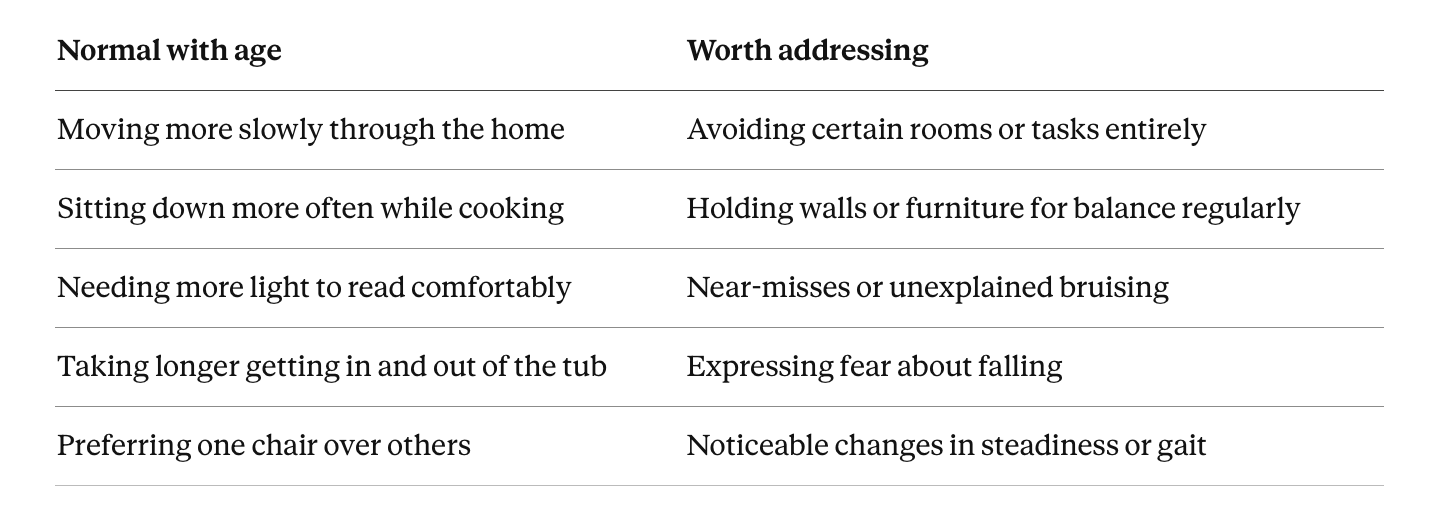
The distinction matters because families sometimes intervene too early on things that do not require intervention, and too late on things that do. Watching patterns over time — rather than reacting to a single observation — usually leads to clearer assessment.
When to Consider a Professional Home Safety Assessment
A family walkthrough is a strong starting point. There are situations where a professional assessment adds something a family cannot easily provide on their own.
Consider a formal assessment when:
A parent has experienced a recent fall, even one they describe as minor
Balance or mobility has changed noticeably in a short period
A parent is managing a condition that affects steadiness, such as Parkinson's disease, neuropathy, or the effects of certain medications
The family disagrees about what level of modification is appropriate
Modifications beyond basic changes are being considered, such as ramp installation, bathroom renovation, or stairlift assessment
A parent is resistant to any changes, and a third-party perspective may be more easily received
An occupational therapist specializing in home assessments can evaluate both the environment and the person's functional capacity together — which produces more accurate recommendations than either assessment alone.
How to Talk About Home Safety With a Parent
What tends to work:
Starting with curiosity rather than concern: "I was looking around the bathroom and wondering if a grab bar might be useful — what do you think?"
Framing changes as practical rather than protective: "This nightlight would make it easier for everyone to see at night."
Asking what feels harder before suggesting what should change.
Acknowledging that the home carries meaning: "I know how much you love this house. I want to make sure it keeps working well for you."
Making one small change and letting the parent experience the difference before suggesting more.
What tends not to work:
Presenting a full list of concerns at once.
Framing changes as responses to a parent's decline.
Making changes without asking.
Enlisting other family members to present a united front without the parent's knowledge.
Treating resistance as a problem to overcome rather than a perspective to understand.
Most parents who resist safety conversations are not resisting safety. They are resisting the implication that they are no longer capable. The conversation goes better when that distinction is respected.
Aging in Place Home Modifications in the GTA: What Families Should Know
For families across the GTA supporting parents who want to stay in their homes, aging in place home modifications cover a wide range — from simple changes a family can make in an afternoon to structural modifications that require professional installation.
Lower-cost modifications families can often handle:
Non-slip mats and bath mats
Motion-sensor nightlights throughout the home
Lever-style door handles replacing round knobs
Raised toilet seats
Handheld showerheads
Decluttering pathways and removing loose rugs
Moving frequently used items to accessible heights
Modifications that typically require professional installation:
Grab bars in the bathroom (must be anchored to studs)
Stair railings and handrails
Ramps at entry points
Walk-in shower conversions
Stairlifts
Widened doorways for wheelchair or walker access
Ontario's Assistive Devices Program and some municipal programs in the GTA offer funding support for certain modifications. An occupational therapist or care advisor can help families understand what may be available based on individual circumstances.
Frequently Asked Questions
What are the most important home safety changes for aging parents?
The changes that make the most consistent difference are those that address the highest-risk moments in daily life: grab bars in the bathroom, adequate lighting throughout the home (especially at night), non-slip surfaces, and cleared pathways. These four areas account for the majority of preventable falls at home.
How do I know if my parent's home is safe enough for them to stay?
There is no single threshold, but the question worth asking is whether the home is supporting your parent's daily life or requiring compensation for it. If a parent is regularly holding walls for balance, avoiding certain rooms, or managing tasks that have become significantly harder, those are signs the home may need to work differently. A professional home assessment can provide a clearer picture when the family is uncertain.
How do I bring up home safety without upsetting my parent?
Start with observation rather than recommendation. Ask what feels harder than it used to. Offer one small change and see how it lands before introducing more. Frame safety as something the home can provide, not something a parent needs because of decline. Most resistance softens when a parent feels heard rather than managed.
What is an occupational therapist's role in home safety for older adults?
An occupational therapist (OT) specializing in aging at home can assess both the physical environment and the person's functional capacity together. They identify risks families may not see, recommend modifications matched to the individual's specific needs, and can provide documentation that supports funding applications for equipment or modifications. A referral can come through a family physician or be arranged privately.
Related Reading
If this article raised questions about what you may have stopped noticing in your parent's home, this week's newsletter explores the emotional side of that shift — and why familiarity is often the last thing families think to question.
Read: The Rooms That Hide the Risk — The Care Standard →
Garrison Care supports families across the Greater Toronto Area who are navigating the early and middle stages of caring for an aging parent. If you have questions about where to start, a Care Advisor is available to help.