How to Choose a Home Care Provider in Toronto: Questions That Matter
Most families begin looking for home care before they feel ready to. The need becomes clear before the knowledge does — and the space between those two things is where many families feel the most uncertain. This guide is for families who want to move through that space with more clarity and less second-guessing.
How to Choose a Home Care Provider in Toronto

Choosing a home care provider is not primarily a logistical decision. It is a trust decision. The logistics — availability, pricing, service scope — are the starting point. What holds care together over time is something harder to measure in an intake conversation: consistency, communication, accountability, and genuine fit between caregiver and the person receiving care.
Families navigating how to choose a home care provider in Toronto are often surprised to find that the most important conversations happen not before care begins, but in the weeks after. How questions are received. How concerns are handled. How much the family feels like a partner in the care rather than a bystander to it.
The difference between care that holds and care that looks right on paper is usually visible within the first two weeks. The goal of this guide is to help families ask better questions earlier — and to know what strong answers sound like before they commit.
Questions to Ask Before Hiring Home Care
The right questions help families understand more than availability or price. They help you see how a provider thinks about care, accountability, and the person receiving support.
Before hiring home care, ask:
Who will be providing the care?
How are caregivers matched with clients?
What happens if the regular caregiver is unavailable?
How are care needs assessed before service begins?
How is the care plan updated over time?
Who does the family contact with questions or concerns?
How are caregivers screened, trained, and supervised?
What is included in the service, and what falls outside the scope?
How are schedule changes communicated?
What does continuity of care look like after the first few visits?
The goal is not to collect perfect answers. The goal is to listen for clarity, steadiness, and whether the provider can explain how care will actually work in daily life — not only what it will look like on paper.
A Framework for Evaluating Any Home Care Provider
A good evaluation should look beyond the first conversation. A provider may sound warm and capable during intake, but care quality becomes clearer through structure, communication, and follow-through. Four areas are worth examining in every provider conversation.
1. Consistency
Ask how the provider maintains consistency when schedules change, caregivers are unavailable, or a parent's needs shift.
Look for answers that explain:
How backup care is handled
Whether the same caregiver can be prioritized
How changes are communicated to the family
How routines and preferences are documented and carried forward
2. Communication
Care becomes easier to trust when families know who to speak with and what to expect.
Ask:
Who is our main point of contact after care begins?
How often will we receive updates?
What happens if we notice a concern?
How are small changes in mood, mobility, appetite, or routine shared with the family?
3. Fit
Care should feel personal. A parent is not a schedule slot.
Ask:
How do you learn about my parent's routines and preferences?
Can we discuss personality fit before matching?
What happens if the match does not feel right?
How do you support dignity and comfort in the home?
4. Accountability
Trustworthy care includes a clear process when something needs attention.
Ask:
How are concerns documented?
Who follows up, and how quickly?
How do you handle feedback from the parent or family?
What does escalation look like if a concern is not resolved?
What Makes Quality Home Care
When families think about what makes quality home care, kindness is usually the first answer. Kindness matters enormously. So do warmth, patience, and genuine respect for a parent's dignity and independence.
Quality care also shows up in quieter, more observable ways:
Reliable arrival times and consistent routines
Clear, proactive communication with the family
A care plan that reflects real daily life, not only the initial intake conversation
Respect for the parent's preferences, habits, and sense of home
Calm, steady handling of changes or concerns
A caregiver who notices small shifts and mentions them without being prompted
A provider who can explain clearly what happens next
Families who have found care that works tend to describe it the same way: it felt like the person genuinely wanted to be there.
Normal vs. Worth Addressing
Not every concern that surfaces during the evaluation process signals a problem. Some uncertainty is a natural part of making an unfamiliar decision. Some is worth taking seriously before committing.
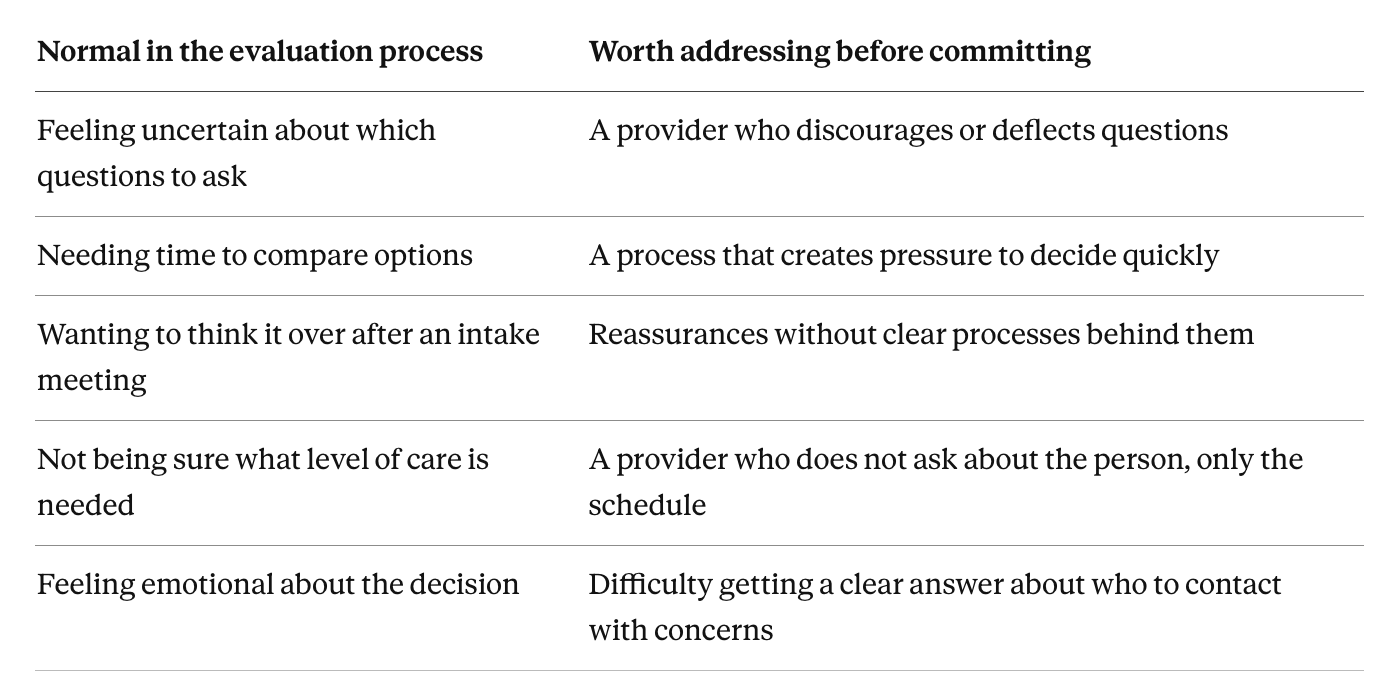
The goal is not to find a provider who removes all uncertainty. It is to find a provider whose answers create calm rather than more questions.
Private Home Care vs Agency: What GTA Families Should Know
For families in Toronto and across the GTA, the question of private home care versus agency care is one of the first structural decisions to make. Both models can provide excellent care. The right choice depends on what a family needs most.
The deeper comparison is not cost or flexibility. It is structure — and specifically, how each option handles the moments when daily life becomes less predictable.
Consider asking both types of providers:
Who is responsible if the caregiver is unavailable?
Who manages screening, training, and supervision?
Who handles scheduling changes, and how?
Who does the family contact when a concern comes up?
How is continuity of care protected over time?
What happens if a parent's needs increase?
Private home care may offer more flexibility and a direct relationship between the family and caregiver. The family typically takes on more coordination responsibility, including backup coverage when a caregiver is unavailable.
Agency or coordinated care generally provides more structure: backup coverage, caregiver supervision, and a clearer accountability chain. The trade-off is less direct control over who comes into the home, and typically a higher cost per hour.
The best choice depends on a parent's needs, a family's capacity, and how much coordination the family wants to carry. Ask both types of providers the same questions and compare how clearly and specifically they answer.
When to Begin Looking for Home Care
Families often begin the search later than they intended — sometimes because the need has built gradually, and sometimes because starting the search makes the change feel more real.
Consider beginning the evaluation process when:
A parent is managing independently but the margin for error has narrowed
A recent health event has changed the level of support needed
Family members are providing informal care and beginning to feel the strain
A parent has expressed reluctance to ask for help but is visibly struggling with certain tasks
Distance makes it difficult to know how a parent is doing day to day
A previous care arrangement has ended and replacement care is needed
A parent's condition is stable but expected to change, and planning ahead would reduce pressure later
Beginning the search before care is urgently needed allows families to evaluate providers thoughtfully rather than reactively. The decision tends to be better when it is not made under pressure.
How to Talk About Home Care With a Parent
Conversations about care can feel sensitive because they touch on independence, privacy, and identity. Tone matters as much as content.
What tends to work:
Starting with what you have noticed, calmly and specifically
Focusing on support rather than loss of independence
Asking what would make daily life easier, before suggesting solutions
Involving the parent in the evaluation process where possible
Using specific examples rather than broad statements
Starting with a limited arrangement and building from there
Helpful language:
"I've noticed the mornings seem a little heavier lately. Would it help to have someone come by a few times a week for support around the house?"
"I want us to look at options before things feel stressful. What kind of help would feel comfortable to you?"
"This is about making home feel easier, not taking over."
What tends not to work:
Presenting the decision as already made
Framing care as a response to what a parent can no longer do
Moving faster than the parent is ready for
Bringing in other family members to add weight without the parent's knowledge
Treating one difficult day as the whole story
Most resistance to home care is not resistance to support. It is resistance to the loss of control the support can seem to represent. The conversation tends to go better when that distinction is held carefully.
Frequently Asked Questions
What questions should I ask before hiring a home care provider?
Ask about caregiver matching, scheduling, backup care, communication, screening, training, supervision, service scope, and how concerns are handled. The strongest answers should explain what happens after care begins, not only what is promised before it starts. A provider who can describe their process clearly and specifically is a provider who has thought carefully about it.
How do I know if a home care provider is trustworthy?
A trustworthy provider communicates clearly, answers direct questions directly, explains their process, respects a parent's dignity, and demonstrates how they maintain consistency over time. Trust is built through follow-through, not only through a warm intake conversation. Pay attention to how the provider responds to your questions as much as what they say.
Should I choose private home care or an agency in the GTA?
It depends on a parent's needs and how much coordination the family wants to manage. Private care may offer flexibility and a direct relationship with a caregiver. Agency or coordinated care typically offers more structure, backup coverage, and a clearer accountability chain. Compare how each option handles scheduling, supervision, communication, and changes in care needs — not only cost and availability.
What is the most important sign of quality home care?
Consistency is one of the clearest signs. Quality care should feel steady over time: familiar routines, respectful communication, reliable follow-through, and a caregiver who notices changes without being prompted. Families who have found care that works tend to describe the same thing: it felt like the person genuinely wanted to be there.
How much does home care cost in Toronto?
Private home care in Toronto is typically priced hourly, with rates varying based on the level of support needed, the provider's structure, caregiver qualifications, and whether care is arranged privately or through an agency. Some costs may be partially offset through insurance, employer benefits, or tax credits. A care advisor can help families understand what options apply to their specific situation.
Related Reading
This week's Care Standard explores the emotional side of choosing care — what families are really listening for when they sit across from a provider, and what consistency actually looks like once care begins.
Read: What You're Really Looking for When You're Choosing Care — The Care Standard →
Garrison Care supports families across the Greater Toronto Area as they navigate the early and middle stages of caring for an aging parent. For families unsure where to begin, a Care Advisor can help clarify the next thoughtful step.