Private Home Care Cost in Ontario: How to Pay and What You're Actually Buying
When families begin exploring private home care cost Ontario, the first question often sounds financial. In practice, it quickly becomes something more personal: What does good care actually include, and how do we know we’re choosing the right kind of support? Understanding what shapes the value of care can make those decisions feel clearer and more confident.
What Does Private Home Care Include?
Private home care is designed to support people in continuing to live safely and comfortably at home. The services included will vary depending on a person’s needs, though most care plans are built around everyday support.
They may include:
Personal care such as bathing, dressing, and mobility assistance
Meal preparation and nutrition support
Medication reminders
Companionship and social connection
Transportation to appointments or errands
Light household assistance
Ongoing communication with family members
Care planning and coordination as needs change
Understanding how these services work together can provide a clearer picture of what a care plan offers beyond any single task. Families exploring what private home care includes in the GTA often discover that continuity, communication, and coordination become just as valuable as the services themselves.

Private Home Care Cost in Ontario: Why Costs Vary
Families naturally want to understand why one care plan may look different from another.
The answer is rarely found in a single factor. It often reflects what is built into the plan beyond the scheduled hours of care.
One helpful way to think about care is through four areas families are investing in together:
Time — the hands-on hours of support
Continuity — familiar caregivers who understand routines and preferences
Coordination — communication that connects each visit into a consistent care experience
Confidence — clearer visibility into what’s happening and why
A rate becomes more meaningful when families understand what it includes and how the care plan functions from one visit to the next.
Home Care Pricing for Toronto Families: What Should You Compare?
Comparing providers becomes much easier when the conversation extends beyond hourly rates.
Helpful questions include:
Who develops and reviews the care plan?
Will the same caregivers visit regularly?
How are changes in health or routine communicated?
Who is the primary point of contact for our family?
How are observations documented and shared?
How does the care plan evolve as needs change?
These questions often provide a clearer picture of how support will feel day to day.
Normal vs. Not Normal
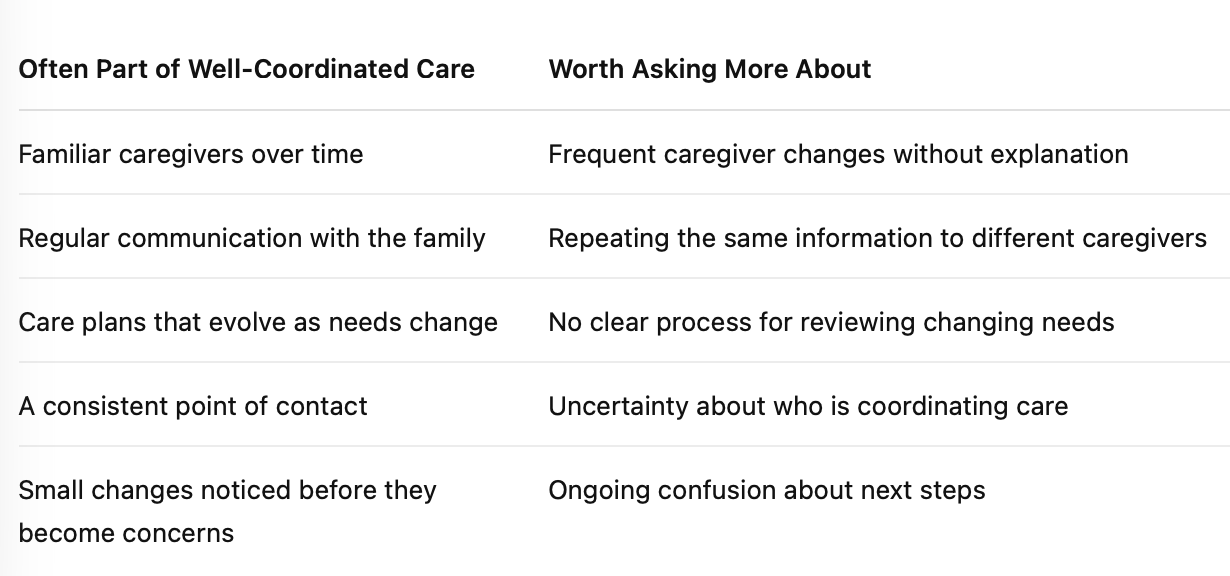
None of these situations automatically indicate a problem. They can simply help identify opportunities for conversation and clarification.
When to Consider Reviewing Your Current Care
It may be worth reviewing your current care plan if:
Family members continue coordinating most day-to-day decisions.
Important information is being repeated frequently.
Communication feels inconsistent.
Care needs have changed since support first began.
The current care plan no longer reflects everyday routines.
Your family remains uncertain about what is included in the existing plan.
A review can create a clearer understanding of what is working well today and how support may continue to evolve over time.
How to Talk About It as a Family
These conversations often feel more productive when they begin with curiosity rather than conclusions.
What Helps
Begin with shared observations.
Ask what is working well today.
Explore what would make daily life feel more manageable.
Focus on the experience of everyone involved, including family caregivers.
Keep the conversation open as needs change over time.
What Usually Makes Conversations Harder
Assuming everyone shares the same understanding.
Focusing only on schedules or costs.
Expecting one conversation to answer every question.
Leaving coordination responsibilities unclear.
Thoughtful conversations often create greater clarity for everyone involved.
Frequently Asked Questions
How much does private home care cost in Ontario?
Costs vary depending on the type of support, the number of hours required, scheduling needs, and the level of coordination included in the care plan. Looking only at hourly rates rarely provides the full picture of how care will work in everyday life.
Does a lower home care rate always mean better value?
Rate alone does not show what a care plan includes. Value may also be reflected in continuity, communication, coordination, and how well the care plan adapts as needs change. Understanding what is included often provides a clearer basis for comparison than price alone.
What should I compare when choosing a home care provider?
Beyond services and scheduling, it is helpful to compare communication, care planning, continuity, coordination, and how the provider adapts as needs change over time.
Related Reading
The Care Standard: The Cost of Getting Care Wrong
This week’s edition explores the quieter side of choosing care—the confidence families are often searching for after support begins, and why meaningful care is remembered less for the tasks completed than for the steadiness it creates.