What to Do When Your Aging Parent Refuses Home Care
When an aging parent refuses home care, families often find themselves caught between real concern and genuine respect. You may have noticed changes in daily life, identified support that could help, and still heard the same answer: "I'm fine. I don't need anyone."
The conversation is rarely only about care. It's also about independence, identity, privacy, and a parent's need to remain in control of their own life. Understanding what's underneath the refusal is usually where a different kind of conversation begins.
Why Aging Parents Refuse Home Care
Refusal rarely comes from stubbornness alone.
For most older adults, independence has been a defining part of identity for decades — being the capable one, the decision-maker, the person others leaned on. Accepting help can feel less like a practical arrangement and more like a statement about who they are now. Most parents aren't ready to make that statement.
There are usually other fears underneath as well: losing privacy, losing control of daily routine, or what accepting help seems to acknowledge about what comes next. A parent who says "I'm fine" may be protecting something they haven't yet found words for.
Knowing this doesn't make the conversation easier. It does change what the conversation is actually about.
How to Convince a Parent to Accept Help
Most families approach this as a problem of logic. If they could explain the options clearly enough, make the right case, show the right information — the parent would come around. Sometimes that works. More often it doesn't, because the resistance isn't coming from a place that logic can reach.
What tends to create more movement is approaching the conversation differently — not as a case to be made, but as a relationship to be honored.
What tends to work:
Asking questions before making a case — what feels harder lately, what would make the week easier, what matters most about staying home
Framing support in terms of what it protects, not what it replaces
Starting smaller than you think necessary — one visit, one task, one familiar face
Allowing the conversation to develop across several exchanges rather than pressing for a decision
Acknowledging your parent's perspective before introducing your own
What tends to backfire:
Leading with safety concerns or risk language
Presenting a fully formed plan before getting any input
Involving multiple family members at once without warning
Treating refusal as a problem to be solved rather than a signal to be understood
Talking to a Resistant Aging Parent About Support
How a conversation begins often determines whether it stays open.
Start with their priorities, not yours
Before any mention of care, ask your parent what's been feeling harder lately. What parts of the day take more out of them than they used to? What would make home feel easier to manage? These questions invite your parent into the conversation rather than positioning them as the subject of it.
Name what you're noticing without making it a verdict
There's a difference between "I've noticed the kitchen feels harder to manage lately" and "You can't be cooking for yourself anymore." The first stays open. The second closes a door.
Let the first conversation be small
A conversation that ends without a decision isn't a failure. A conversation that ends with the relationship intact is progress. The goal at first is simply to stay in contact with the subject — not to resolve it.
Is It Normal for an Aging Parent to Refuse Help?
Most resistance is a normal part of a difficult adjustment. Some situations call for a different level of attention.
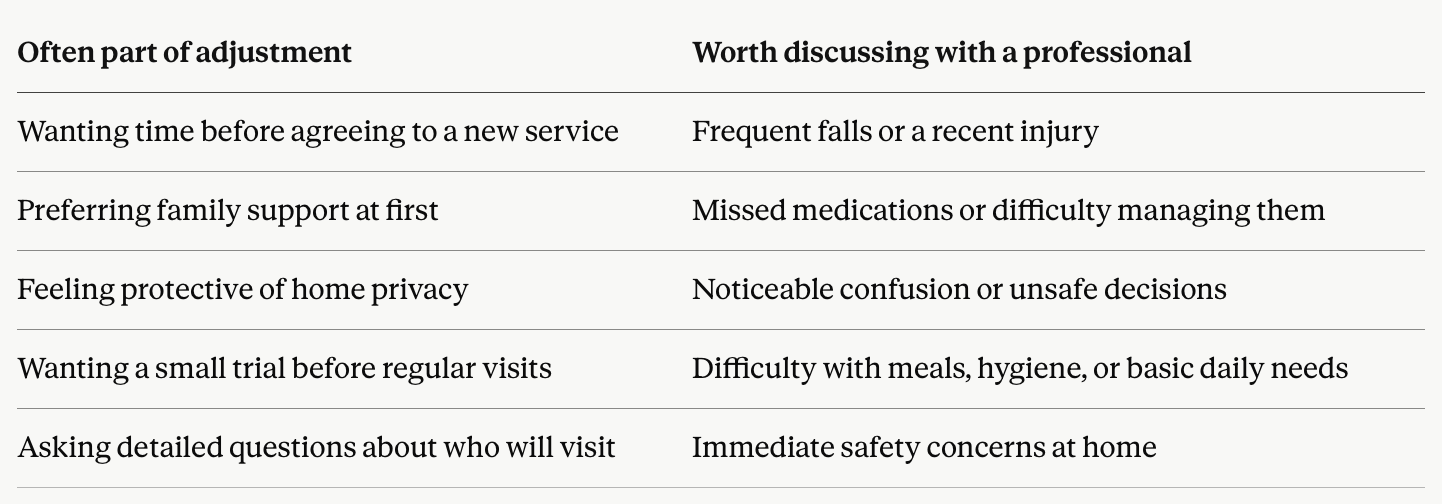
This is not a diagnostic tool. It can help families distinguish between a parent who needs time and a situation that deserves outside guidance.
When to Consider Getting Outside Support
Some conversations benefit from a neutral voice. It may be worth reaching out to a care advisor, family doctor, or social worker if:
The same conversation has repeated without any movement
The relationship is taking damage from ongoing disagreement
A health event — fall, hospitalization, new diagnosis — has changed the picture
You're unsure whether your parent's resistance reflects preference or something more
Family members are involved but not aligned on how to proceed
Outside support isn't a last resort. For many families it's simply a way to get a clearer picture before the next conversation.
What if a Parent Won't Accept Care in the Toronto Area?
For families navigating this in Toronto, where a parent won't accept care despite real need, the first step is often a quieter one than families expect — not a care plan, but a single conversation about what matters most to your parent about their daily life.
Local options vary in cost, structure, and fit. A family doctor, social worker, or care coordinator can help clarify what level of support may be appropriate and which options a parent might be more willing to consider. Starting with one specific, limited form of support — a companion for appointments, help with groceries, a regular check-in — often creates more openness than introducing a full schedule of care.
What to Do When Your Aging Parent Refuses Home Care
When families ask what to do when an aging parent refuses home care, the answer is rarely a single conversation or a single decision. It's a direction — one that keeps dignity and relationship at the center, and moves at a pace the person can follow.
That means staying in the conversation steadily, without forcing. Returning to the subject without making it the only subject. Noticing small movements — a parent who was completely closed and is now willing to talk is making progress, even when nothing has been decided.
The goal at first isn't agreement. It's enough trust for the next conversation to feel possible.
Frequently Asked Questions
Can you force an aging parent to accept home care?
A capable adult has the right to make decisions about support in their own home, even when family members are concerned. Situations involving significant safety risk, serious cognitive change, or an inability to meet basic needs deserve guidance from a healthcare or social-service professional rather than a family decision made alone.
How do I convince my parent to accept help?
Start by listening for what the refusal is protecting. A parent may be more open to one specific, practical form of support than to the broader idea of home care. Focus on their priorities, offer choices where possible, and allow the conversation to continue over time rather than pressing for resolution.
Can home care start with only a few hours a week?
Yes. Support can begin with a small, defined purpose — meal preparation, companionship, transportation, light household tasks, or recovery support after a hospital stay. A smaller start often helps a parent understand what support actually feels like before committing to more.
What should I do if my parent lives alone and refuses help?
Stay connected to what's changing in daily life. Keep the conversation open about what your parent wants to preserve. Consider involving a trusted healthcare professional when concerns are growing. If there is an immediate safety risk, seek local support promptly.
Related Reading
This week's edition of The Care Standard goes deeper into the emotional side of this conversation — why refusal happens, what tends to shift, and how to stay in it without losing the relationship.
[Read this week's newsletter: "I Don't Need Help." — And What You Do Next →]