Long-Distance Caregiver: How to Coordinate Aging Parent Care Across the GTA
Managing a parent's care from across the city — or across the province — is one of the most common and least-discussed challenges families face. The distance is rarely the problem. The problem is what the distance creates: fragmented information, uneven sibling involvement, and the quiet accumulation of one person holding more than their share. This guide is for the adult child who has become the default coordinator and is looking for a steadier way to manage.
Managing Aging Parent Care From a Distance
For many GTA families, long-distance caregiving does not mean living in another city. It means living in Mississauga while a parent lives in Scarborough. It means a 40-minute drive that requires planning, a workday that gets interrupted by calls, and a mental load that does not clock out when the workday ends.
As a long distance caregiver supporting an aging parent in the GTA, the coordination overhead is often invisible to everyone except the person carrying it. Appointments are being booked. Medications are being managed. Siblings are being updated. From the outside, everything looks handled. From the inside, it is held together by one person's memory, availability, and emotional stamina.
The goal of this guide is to help that person build something more sustainable.
What Long-Distance Caregiving Actually Involves
Long-distance caregiving is broader than most families expect when they first take it on. It typically includes:
Coordinating medical appointments and follow-up care
Managing medications and prescription refills
Communicating updates to other family members
Monitoring changes in a parent's health, mood, or daily functioning
Arranging transportation to appointments
Liaising with home care providers, doctors, and other professionals
Managing household tasks, grocery delivery, and home maintenance remotely
Making time-sensitive decisions when something changes unexpectedly
Advocating for a parent's needs within the healthcare system
Each of these tasks is manageable individually. The challenge is that they arrive simultaneously, often without warning, and they tend to land on the same person every time.

The Coordination Tax: What It Is and Why It Matters
The coordination tax is the mental load of being the person who connects the loose ends. It is not the care itself — it is the tracking, the anticipating, the following up, and the remembering that surrounds it.
For many long-distance caregivers, the coordination tax shows up as:
Checking the phone during meetings, meals, and evenings
Keeping a running mental list of things to follow up on
Fielding calls that require immediate decisions without full information
Translating medical updates into language a parent or sibling can understand
Feeling responsible for things that have not happened yet
Carrying the anxiety of not knowing what is happening between visits
The coordination tax is rarely visible to other family members. Because capable people tend to manage it quietly, the people around them may not realize how much is being held together — or how close to capacity the primary coordinator is.
Naming it is the first step toward addressing it.
Family Caregiver Coordination in Toronto: How Roles Get Assigned
Family caregiver coordination in Toronto most often happens by default rather than by design. One adult child lives closest. One has the most flexible schedule. One understands the medical updates better. One parent calls one child first. Over time, that child starts answering, then following up, then organizing, then remembering — and the role becomes permanent before anyone has agreed to it.
This matters because roles assumed by default tend to lack clear boundaries. The default coordinator often ends up responsible for everything, including the things they were never explicitly asked to do, because no one else knows to do them.
A more intentional approach involves naming the roles that exist and deciding who holds each one — not because families need a formal agreement, but because clarity reduces the invisible load that builds when everything lives in one person's head.
Questions that help clarify caregiving roles:
Who is the primary contact for medical updates?
Who coordinates appointments and transportation?
Who communicates changes to other family members?
Who handles financial or administrative tasks?
Who makes decisions when something changes unexpectedly?
Who checks in with the parent most frequently, and how?
Who is the backup when the primary coordinator is unavailable?
These questions do not need to be answered all at once. They are most useful as a starting framework for a family conversation — one that names what is already happening and asks whether it is working.
Sibling Caregiver Roles: How to Share Responsibility More Evenly
For families navigating sibling caregiver roles for an aging parent in Ontario, the challenge is rarely that siblings do not care. The challenge is that care has never been explicitly organized, so it defaults to whoever is most available, most local, or most willing to step in.
Uneven distribution of caregiving responsibility is one of the most common sources of family tension during this period. It is worth addressing directly rather than letting it build.
What even distribution actually looks like:
It does not mean equal hours. It means that each family member has a defined role that matches their capacity, location, and availability — and that no single person is the default for everything.
Roles that can be distributed regardless of distance:
Research and administration: Identifying resources, comparing providers, managing paperwork — tasks that can be done from anywhere.
Financial oversight: Managing bills, insurance, benefit claims, or financial planning support.
Remote check-ins: Regular phone or video calls with the parent to maintain connection and notice changes.
On-the-ground presence: Local siblings or family members handling visits, appointments, and in-person tasks.
Communication coordination: One person consolidating updates and sharing them with the broader family so the primary caregiver is not repeating information to multiple people.
Decision-making backup: Agreement in advance about who is consulted for different types of decisions, so they do not all default to one person.
The goal is a structure where each person knows what they are responsible for — and where the primary coordinator is not the only one paying attention.
Normal vs. Worth Addressing
Not every aspect of long-distance caregiving that feels hard signals a problem that needs immediate intervention. Some difficulty is inherent to the situation. Some is worth addressing before it becomes a crisis.
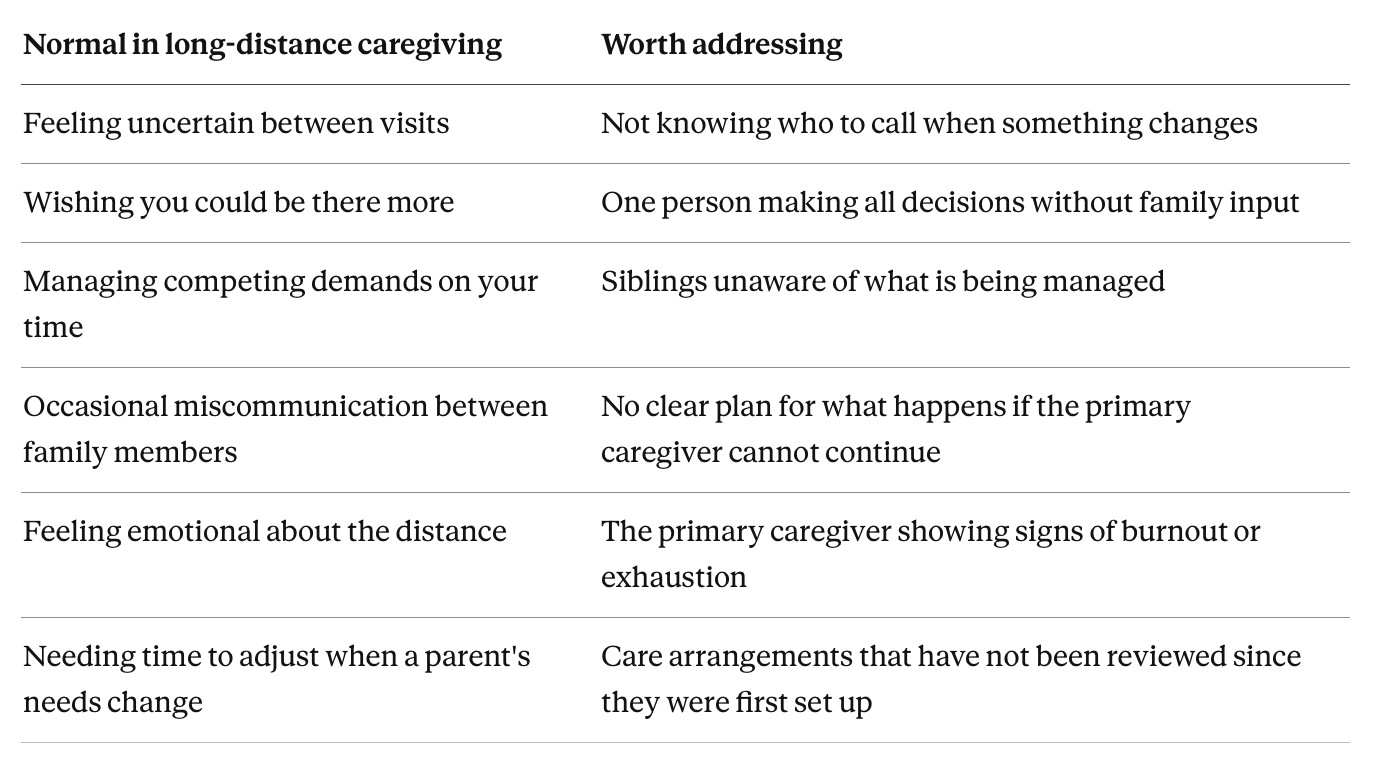
The distinction matters because families sometimes wait for a crisis before making structural changes — and by that point, the options are narrower and the decisions are harder.
When to Consider Additional Coordination Support
Most families reach a point where informal coordination is no longer sufficient. Consider looking for additional structure or support when:
The primary caregiver is managing most tasks alone and showing signs of strain
There is no clear backup when the primary coordinator is unavailable
Siblings are not consistently informed or involved
A parent's needs have increased and the current arrangement has not been updated to reflect that
Communication between family members is fragmented or inconsistent
A parent has recently experienced a health event that changes the level of support needed
The family is considering home care but is not sure how to evaluate or coordinate it
The primary caregiver lives more than 30 minutes away and visits require significant planning
A parent is resistant to accepting help, and the family needs a third-party perspective
The family is managing multiple care relationships — home care, medical, pharmacy, community supports — without a central coordination point
Reaching this point is not a failure of the family. It is a signal that the situation has grown beyond what informal coordination was designed to handle.
How to Talk About Coordination With Your Family
What tends to work:
Starting with what is already happening rather than what is wrong: "Here is what I have been managing — I want to make sure we have a shared picture of it."
Naming the coordination load specifically rather than speaking in general terms: "I am the one who gets the calls, tracks the appointments, and updates everyone. I need us to think about how to share that more."
Framing the conversation as planning rather than complaint: "I want to make sure we have a structure that works for everyone, including me."
Asking each sibling what they can realistically contribute given their circumstances.
Agreeing on a communication rhythm so updates do not have to be repeated to multiple people individually.
Revisiting the conversation when a parent's needs change, rather than assuming the current arrangement still fits.
What tends not to work:
Raising the issue in the middle of a crisis, when emotions are already elevated.
Framing the conversation as a scorecard of who has done more.
Expecting one conversation to resolve everything permanently.
Waiting until the primary caregiver is exhausted before naming that the arrangement is not sustainable.
Assuming siblings know what is being managed without being told.
Most families who struggle with uneven caregiving distribution have never had an explicit conversation about it. The distribution was assumed, not agreed upon. A direct, calm conversation — even an imperfect one — is almost always more effective than waiting for the situation to resolve itself.
Frequently Asked Questions
What is a long-distance caregiver?
A long-distance caregiver is an adult child or family member who provides coordination, oversight, and support for an aging parent from a geographic distance. In the GTA context, this often means managing care from a different part of the city rather than a different province — close enough to be involved, but far enough that every visit requires planning. Long-distance caregiving typically involves a higher proportion of coordination work — scheduling, communicating, researching, and decision-making — relative to in-person physical care.
How do I coordinate my parent's care when I live far away?
Start by mapping what coordination is already happening and who is doing it. Identify the tasks that can be managed remotely — research, communication, financial administration, phone check-ins — and those that require in-person presence. Establish a communication rhythm with your parent and with other family members so updates are shared consistently rather than repeated individually. Consider whether a care coordinator, home care provider, or care advisor could take on some of the coordination load that is currently resting with one family member.
How do I talk to my siblings about sharing caregiving responsibilities?
Start with a clear, specific picture of what is currently being managed rather than a general statement about feeling overwhelmed. Name the tasks rather than the feelings first — it makes the conversation easier to engage with. Ask each sibling what they can realistically contribute given their circumstances, rather than assuming everyone should contribute equally. Agree on a structure for communication and decision-making so the primary caregiver is not the only point of contact for everything. Revisit the conversation when a parent's situation changes.
When should a family consider hiring a care coordinator?
A care coordinator becomes useful when the volume of coordination — appointments, providers, communication, decision-making — has grown beyond what one family member can manage alongside their own life and work. It is also worth considering when the family is geographically spread out, when siblings are not consistently involved, when a parent's needs are complex or changing, or when the primary caregiver is showing signs of strain. A care coordinator does not replace family involvement — they provide the structure that allows family members to be present in ways that matter most, rather than absorbed entirely by logistics.
Related Reading
This week's Care Standard explores the emotional experience of being the one who manages it all from a distance — the coordination tax, the invisible weight, and what changes when the arrangement stops resting entirely on one person.
Read: The One Who Manages It All From a Distance — The Care Standard →
Garrison Care supports families across the Greater Toronto Area as they navigate the early and middle stages of caring for an aging parent. For families unsure where to begin, a Care Advisor can help clarify the next thoughtful step.