What Does Home Care Include in Ontario? A Plain-Language Guide for Families
When a parent starts needing support at home, many families quickly realize they are not entirely sure what home care includes. The phrase can mean different things depending on the provider, the level of need, and whether support is publicly funded, privately arranged, or both. This guide explains what home care can include, what families should expect, and how to recognize when support is starting to fit.
What Does Home Care Include in Ontario?
Home care in Ontario is not a single service. It is a range of supports that can be arranged privately, through a home care agency, or through the publicly funded system coordinated by Home and Community Care Support Services (HCCSS, formerly the LHIN).
What does home care include in Ontario depends on the type of arrangement a family chooses and the level of support their parent needs. Broadly, home care falls into two categories: personal support and health care services.
Personal Support Services
Personal support helps with daily routines that may have become harder to manage alone:
Assistance with bathing, dressing, grooming, and personal hygiene
Meal preparation and encouragement around nutrition
Light housekeeping and laundry
Medication reminders (not administration, unless a regulated professional is involved)
Companionship and social engagement
Mobility assistance and fall-risk awareness
Transportation to appointments
Respite care for family caregivers
Home Health Care Services
Health care services typically require regulated professionals and include:

Nursing care and wound management
Physiotherapy and occupational therapy
Speech-language pathology
Social work support
Dietitian services
Palliative care support
Not every provider offers every service. The scope of what is available, and what is funded, depends on whether a family is accessing publicly funded care or arranging private support.
Home Care Services for Aging Parents in Toronto
Home care services for aging parents in Toronto vary significantly depending on the provider, the model of care, and how the arrangement is structured. The five categories families most commonly need are:
Personal care. Help with bathing, dressing, grooming, toileting, and moving safely through the home.
Homemaking and meals. Light household tasks that support daily living, meal preparation, dishes, laundry, and keeping commonly used spaces safe and manageable.
Companionship. Conversation, encouragement, and a calm presence in the home, especially meaningful when a parent spends long stretches of time alone.
Respite. Time for family caregivers to rest, work, or manage other responsibilities, knowing someone is present with their parent.
Care coordination and family communication. Updates, changes noted, concerns shared, and a care plan that adjusts as needs evolve.
Publicly Funded vs. Private Home Care in the GTA
Families in Ontario have access to two main pathways. Understanding the difference helps avoid assumptions about what is included.
Publicly Funded Home Care Through HCCSS
Families can request a home care assessment through their family doctor, a hospital, or directly through HCCSS. A care coordinator assesses the parent's needs and determines eligibility for funded services.
Publicly funded home care in Ontario typically covers:
Personal support worker (PSW) visits for daily living assistance
Nursing visits for medically complex needs
Therapy services when medically indicated
Short-term or transitional support after hospitalization
What families should know: Publicly funded care is based on assessed need, not family preference. Wait times vary. Funded hours are often limited and may not cover the full scope of daily support a family expects or requires.
Private Home Care Options in the GTA
Private home care options in the GTA give families more direct control over scheduling, caregiver consistency, and the type of support provided. Families pay out of pocket, through insurance, or through employer benefit plans.
Private home care typically offers:
Greater flexibility in scheduling and frequency
More control over caregiver selection and consistency
Broader scope of non-medical support
Faster access without wait times or eligibility assessments
What families should know: Quality varies significantly between providers. Families should ask directly about caregiver training, supervision, backup coverage, and how care plans are built and updated.
A family may use private care on its own, or alongside publicly funded services, when they need more hours, more flexibility, or a more personalized arrangement than the funded system provides.
What to Expect From a Home Care Provider
Knowing what to expect from a home care provider helps families ask better questions before care begins — and recognize whether the care they are receiving is what good support actually looks like.
What should be standard:
A thorough intake process that goes beyond scheduling to understand the parent as a person
A written care plan that reflects specific routines, preferences, and needs
A consistent caregiver who is familiar with the parent's daily rhythm
Proactive communication about changes, concerns, or adjustments needed
A clear point of contact for questions and concerns
A process for updating the care plan as needs change
Respectful, dignified support that centres the parent's comfort and independence
Worth asking for, even if not always offered:
Regular family updates on a set schedule
A named care coordinator or supervisor who oversees the caregiver relationship
A formal review of the care plan at agreed intervals
Written documentation of visits, observations, and concerns noted
Families who ask for these things early tend to have better outcomes, not because the questions change the care, but because they signal to the provider that the family is engaged and expects follow-through.
Questions to Ask Before Choosing a Home Care Provider
Before care begins, families can ask practical questions that reveal how clearly the provider thinks about care.
About the caregiver:
How are caregivers matched with clients?
Will the same caregiver come consistently, or will there be rotation?
What training and background checks are standard?
What happens when the regular caregiver is unavailable?
About the care plan:
What does a typical visit look like for someone in my parent's situation?
How do you learn personal preferences and routines?
How often is the care plan reviewed and updated?
Who do we contact if something needs to change?
About communication:
Who is our main point of contact?
How does the provider communicate with the family between visits?
How are concerns handled if something does not feel right?
The clearer the answers, the easier it becomes to assess whether the care is a good fit.
Normal vs. Worth Addressing
Some uncertainty is expected when care first begins. Other patterns are worth raising directly with the provider.
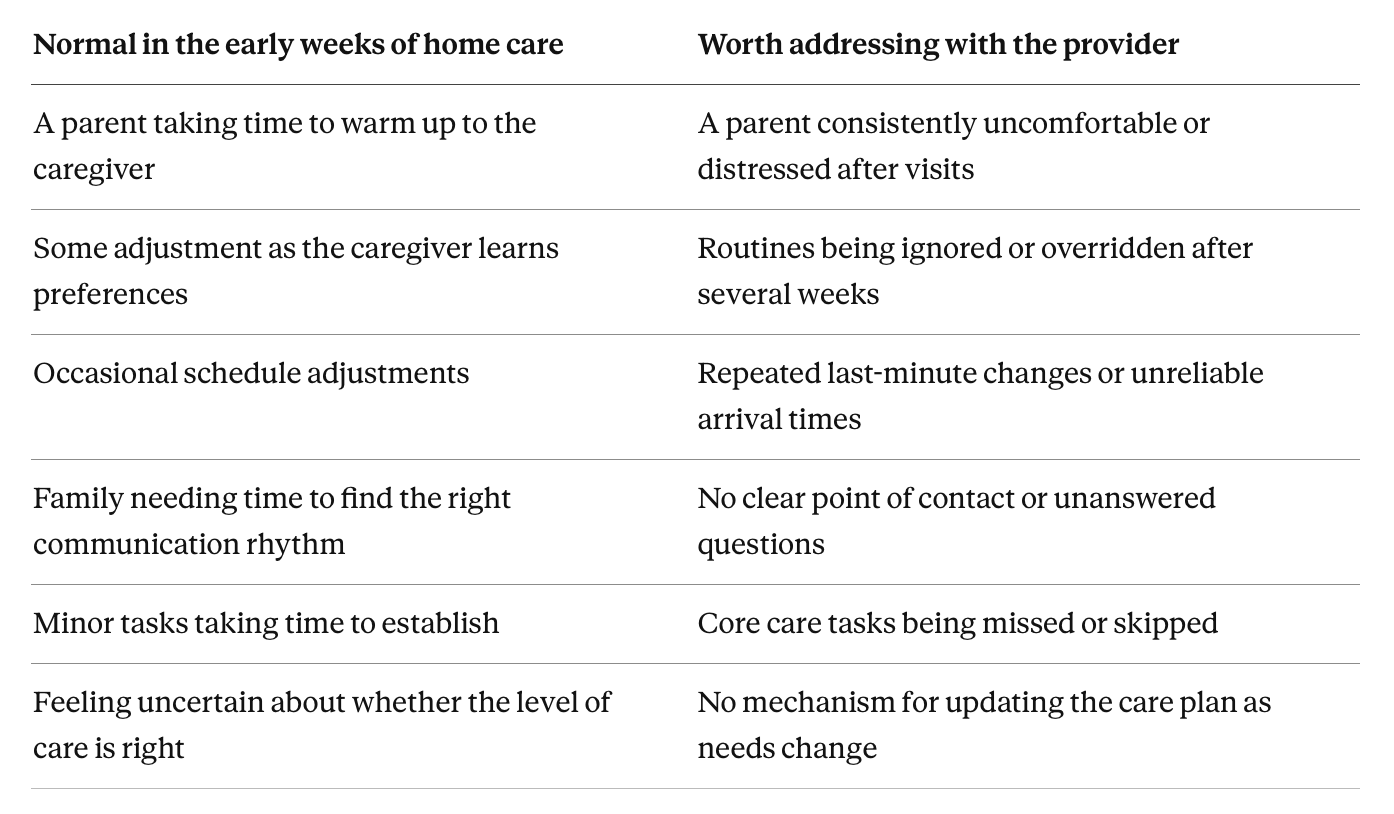
One difficult visit or one miscommunication does not mean the care is wrong. A repeated pattern does. Providers who take feedback seriously and respond directly are a good sign. Providers who deflect or minimize concerns are worth reconsidering.
When to Consider Adjusting or Expanding Home Care
Families sometimes hold an arrangement in place longer than is useful because they are not sure whether what they are noticing warrants a change.
Consider reviewing the current arrangement when:
A parent's daily needs have changed since the care plan was last updated
The current level of support no longer feels sufficient
A parent has had a fall, a health event, or a significant change in mobility or cognition
The family is spending significant time managing coordination the provider should be handling
A parent expresses discomfort with the current caregiver or arrangement
The family has lost confidence in the provider's responsiveness or communication
Care was set up after a hospital discharge and has not been reviewed since
The primary family caregiver is showing signs of strain that better support could reduce
Reviewing a care arrangement is not the same as ending it. Often, a direct conversation with the provider about what is and is not working is enough to recalibrate.
How to Talk About Home Care With a Parent
Conversations about care can feel sensitive. Many parents hear "home care" and worry it means losing independence. The way the conversation begins matters.
What tends to work:
"I want to understand what would make the day feel easier for you."
"Would it help to have someone support the parts of the week that feel heavier?"
"This does not have to be a big change. We can start with what feels useful."
"I want us to look at support that helps you stay comfortable at home."
"Let's talk about what kind of help would actually feel respectful."
What tends not to work:
"You can't manage anymore."
"We already decided you need help."
"You're not safe alone."
Presenting a list of concerns without first asking how the parent is experiencing daily life
Making changes to the care arrangement without the parent's knowledge or input
A better conversation starts with the parent's experience, not a service list. Most parents want support that feels right for them — and that conversation goes better when their preferences are the starting point.
Frequently Asked Questions
What does home care cover in Ontario?
Home care in Ontario covers a range of personal support and health services depending on whether care is publicly funded or privately arranged. Publicly funded home care — coordinated through HCCSS — covers personal support worker visits, nursing care, and therapy services based on assessed need. Private home care covers a broader and more flexible range of personal support services arranged directly with an agency or provider. The specific services included depend on the care plan, the provider, and the level of support required.
Is home care in Ontario covered by OHIP?
Some home care services in Ontario are covered through the publicly funded system, not OHIP directly. Families who qualify through a HCCSS assessment can receive funded personal support, nursing, and therapy services at no direct cost. Private home care is not covered by OHIP and is paid for out of pocket, through private insurance, or through employer benefit plans. Some costs may be partially offset through the Medical Expense Tax Credit. A care advisor can help families understand what funding options may apply to their situation.
What is the difference between a PSW and a nurse in home care?
A Personal Support Worker (PSW) provides non-medical personal care and daily living support — help with bathing, dressing, meals, light housekeeping, companionship, and mobility. A nurse provides medically regulated care, including wound care, medication administration, health monitoring, and care coordination for complex needs. Some home care arrangements include both. Whether nursing care is needed depends on the parent's medical situation and is typically assessed by a regulated health professional.
How do I know if home care is the right fit?
Home care is working well when support matches the person's routines, preferences, and safety needs — and when the family understands what is being provided and how the plan will adjust as things change. Good care should feel specific, consistent, and built around a real person. Families should not be left guessing about what happened during visits or uncertain about who to contact with concerns.
Related Reading
This week's Care Standard explores the gap between what families imagine home care to be and what they discover it actually involves, and what good support looks and feels like once it is in place.
Read: What Home Care Actually Covers — And How to Know It's Right — The Care Standard →
Garrison Care supports families across the Greater Toronto Area as they navigate the early and middle stages of caring for an aging parent. For families unsure where to begin, a Care Advisor can help clarify the next thoughtful step.